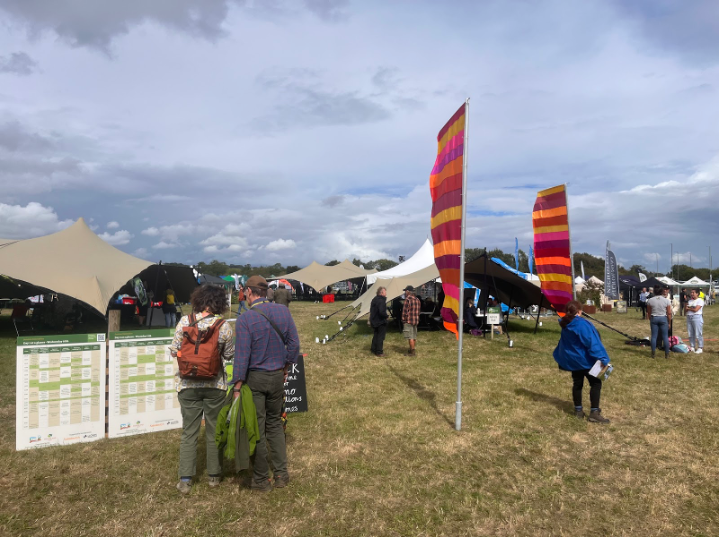
In September, Woodoaks Farm in Hertfordshire hosted The Agroforestry Show: part festival, part field day, part buffet. We went along with our heads, hearts and appetites open. Here’s what we digested, and how it connects to the work we do at Common.
HEAD: SENSE-MAKING
The Agroforestry is more than just aligning food production and woodland management. It is a range of ways of normalising the presence of trees on farmland, with benefits to both. For farmers used to familiar field shapes and long-held techniques and systems, that’s no small shift. One theme at the show was the idea of gentle integration: starting with what feels familiar, like thinking of hedges as an agroforestry feature.
We took note of some clear distinctions emerging: trees grown for forestry products (timber, cricket bats), and trees grown for horticulture (orchards, vineyards). This clarity helps, but it also brings to light the helpful truth that farmers value choices.
Choices alone aren’t enough, however. Decisions about land, and which trees find a home there, can’t sit solely with individual landowners. The future health of our landscapes depends on shared power and shared decision-making, with communities, workers, and future generations all at the table.
There was also a financial reality check: a session on digital financial planning tools made it clear that agroforestry projects often need 10+ years to break even. In practice, this means philanthropic or grant capital is vital to help get projects off the ground.
HEART: IMPRESSIONS
The show wasn’t just about spreadsheets, but also an exploration of collaboration. We heard about an emerging idea to form an agroforestry cooperative: a way to get products to market more effectively, yes, but also to experiment with what cooperation means beyond business transactions.
We also couldn’t ignore the conversation around Natural Capital and Biodiversity Net Gain (BNG). Trees will play a huge role in helping housing developers and infrastructure companies to demonstrate biodiversity uplift. And the revenues from selling offsite credits could be significant. But there’s also a risk: landowners hold a lot of power, both in receiving funds and deciding how they’re spent.
At the heart of this issue is fairness. We’d love to see more landowners working with communities; not just to share natural capital revenues, but to take up their rightful role in the decision-making. That way, BNG can genuinely serve both landscapes and local needs.
APPETITE: NOURISHMENT
The Agroforestry Show also reminded us that farming is about what sustains people, not only what sustains land. That means tackling the very practical question of who has the security and resources to farm well.
The Law Commission has recently been asked to review the regime governing agricultural tenancies. Much of England and Wales is farmed by tenants, yet the current system often leaves them with short-term agreements, limited rights, and little incentive or freedom to invest in long-term practices like agroforestry.
If agricultural law shifts towards giving tenant farmers more security, more scope to diversify, and the confidence to invest, it could truly be a source of nourishment, for landscapes, communities, and future generations. At Common, we hope the review sparks the development of healthier power dynamics between landowners, tenants and communities, encouraging landowners to share more of the wealth, resources, and value that the privilege of landownership brings.
We know that sustainable food systems depend on fairer land systems. That’s how we ensure that agroforestry, and farming more broadly, feeds more than markets: it feeds people, new possibilities, and regenerative futures.
DIGESTING IT ALL
Walking away from Woodoaks, our heads were deep in consideration of new frameworks, our hearts were stirred by the potential for cooperation, and our appetites were renewed for action.
At Common, we’re ready to help landowners, farmers, and communities turn these insights into action:
- Designing agroforestry systems that balance ecology and economy
- Facilitating collaboration across stakeholder ecosystems
- Exploring how tools like BNG can serve both landscapes and local people
If you’d like to explore how your land can host trees, projects, and partnerships that make sense for you and your organisation, we’d be glad to say hello.